A cosmetics or pharma buyer who accepts "asbestos-free talc" on a supplier's word — without the test method and the certifying laboratory named on paper — carries the exact liability exposure that drove the Johnson & Johnson talc litigation. Third-party asbestos screening has been a hard requirement for cosmetic and pharmaceutical talc since 2018, and it is only one of four specs that separate a commodity industrial filler from a certified pharma excipient priced many times higher. Talc is not one product sold at one price; it is a spec class where the certificate, not the mineral, is what you are buying. This guide walks the spec sheet a procurement team should demand before the next talc order.
The 60-Second Read
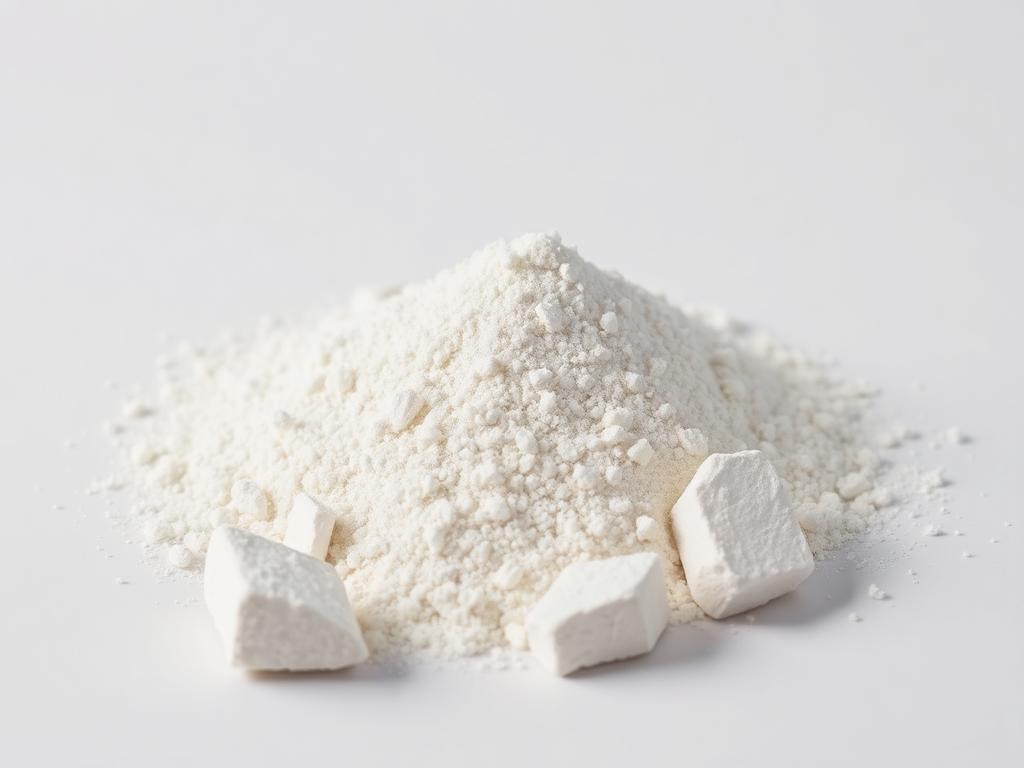
Talc (hydrated magnesium silicate, Mg₃Si₄O₁₀(OH)₂) is a phyllosilicate filler for paints, plastics, paper, ceramics, cosmetics, and pharmaceuticals — global production ~7–8 Mt/yr (USGS Mineral Commodity Summaries 2026). Grade is defined by four things: whiteness, particle-size distribution, asbestos-free certification, and platelet aspect ratio. Bare Syndicate's talc ships in three tiers — industrial lumps (90%+ whiteness), micronized 325-mesh powder (92%+, asbestos-free), and cosmetic/pharma grade (95%+, USP/BP, asbestos-free certified). Because certification and whiteness drive value, cosmetic and pharma talc trades at 5–10× industrial filler. The buyer's question is never "is it talc" — it is which certificate the application legally requires.
The Asbestos-Free Certification Chain, Post-J&J
For cosmetic and pharmaceutical talc, the asbestos certificate is the load-bearing spec, not a formality. The US FDA position on cosmetic talc requires asbestos screening by polarised light microscopy (PLM), transmission electron microscopy (TEM), or both; USP General Chapter <1119> and European Pharmacopoeia 2.4.4 specify the pharmaceutical testing methods; and ISO 22262-1 and 22262-2 define the analytical methods for asbestos in industrial mineral products. The procurement discipline is simple: never accept "asbestos-free" without the **test method (PLM, TEM, or XRD) and the certifying laboratory** named on the certificate. "Asbestos-free" as a bare phrase, with no method and no lab, is worth nothing in a product-liability file.
Whiteness, Particle Size, and Aspect Ratio: The Filler Specs
Beyond the asbestos certificate, three measured specs decide how talc performs. Whiteness — measured on a calibrated ISO 2470 (ISO brightness) or Hunter Lab device, not eyeballed — drives opacity and colour in paint, paper, and plastics; premium grades run 92–95%+. Particle-size distribution (the top cut, d50, and d97) governs surface finish, dispersion, and gloss; micronized fillers are specified to a 325-mesh cut. And platelet aspect ratio (length:thickness) determines the reinforcing effect in polymer compounds — high-aspect-ratio talc stiffens polypropylene, which is why compounders specify it, not just the whiteness.
Matching Talc Grade to the End-Use
The three tiers — 90%, 92%, and 95%+ whiteness — map to distinct applications and price bands. Don't over-specify (paying pharma certification for a ceramic body) or under-specify (running uncertified filler into a cosmetic line):
| Grade | Whiteness | Key spec | End-use |
|---|---|---|---|
| Industrial Lumps | 90%+ | 0–100 mm, grinding feed | Ceramic body, grinding plants |
| Micronized 325 Mesh | 92%+ | Asbestos-free, fine cut | Paint fillers, plastic compounding |
| Cosmetic / Pharma | 95%+ | USP/BP, asbestos-free certified | Cosmetics, pharma excipient |
The tiering is why a single "talc price" is meaningless — the cosmetic-versus-plastic-filler-versus-ceramic-body spread runs 5–10× on the same base mineral.
USP vs BP/EP vs JP: Don't Classify Pharma Talc Generically
"Pharmaceutical grade" is not a specification — the pharmacopoeia is. USP (United States), BP/Ph. Eur. (UK/Europe), and JP (Japan) have different monographs and testing requirements for talc, so a lot certified to one is not automatically compliant with another. A pharma buyer sourcing for multiple markets specifies each destination's monograph explicitly (USP, BP, Ph. Eur., or JP) — and confirms the certificate covers it — rather than accepting a blanket "pharma grade" claim. The same rigour applies to the customs line: HS 252610 covers natural unground talc, HS 252620 covers crushed or powdered.
Where Talc Procurement Trips Up
- Accepting "asbestos-free" without the method and lab. The certificate must name PLM, TEM, or XRD and the certifying laboratory — a bare claim is not a certificate.
- Quoting one "talc price." The cosmetic vs plastic-filler vs ceramic-body spread is 5–10× — the grade, not the mineral, sets the price.
- Eyeballing whiteness. Whiteness is a measured value on ISO 2470 or Hunter Lab; "very white" is not a spec.
- Classifying pharma talc generically. USP, BP/Ph. Eur., and JP monographs differ — specify the destination's pharmacopoeia.
- Ignoring aspect ratio for polymer work. For polypropylene reinforcement the platelet aspect ratio matters as much as whiteness — specify it.
- Confusing the HS code. Unground (252610) and powdered (252620) talc are different customs lines with different duty treatment.
What to Verify Before Signing
- Asbestos certificate — test method (PLM / TEM / XRD) and certifying laboratory named, per FDA / USP <1119> / ISO 22262.
- Whiteness — a measured ISO 2470 (or Hunter Lab) value, not a description.
- Particle size — top cut, d50, and d97 stated; mesh cut for micronized grades.
- Pharmacopoeia — USP, BP, Ph. Eur., or JP named for pharma lots.
- Aspect ratio — stated where the end-use is polymer reinforcement.
- Independent assay — third-party lab (SGS, Bureau Veritas) results on the shipped lot, and HS classification (252610 vs 252620).
Next step: Review grade specifications and certification documentation for talc (industrial, micronized, and cosmetic/pharma grades), or request a delivered-cost indication with the whiteness, particle-size, asbestos-test, and pharmacopoeia figures spelled out for your application. The full portfolio sits under the Minerals & Mining division; for the wider strategic-minerals context see our overview of five industrial minerals and our guide to mastering mineral quality.
Additional Context
The foundational references for talc procurement are the USGS Mineral Commodity Summaries (annual talc and pyrophyllite chapter) for production and trade, the US FDA cosmetic-talc page and USP / European Pharmacopoeia monographs for the certification requirements, ISO 22262 for asbestos analytical methods, and IMA-Europe (Industrial Minerals Association) for application guidance. Pricing is assessed quarterly by Fastmarkets Industrial Minerals; independent inspection by SGS or Bureau Veritas at origin is the contractual default for any talc lot of meaningful tonnage.
Last reviewed: 2026-07-04. Grade tiers, whiteness bands, and certification requirements are sourced to USGS MCS 2026, the US FDA, USP/Ph. Eur. monographs, and ISO 22262; verify the asbestos test method, whiteness value, and pharmacopoeia against an independent certificate before contract execution.